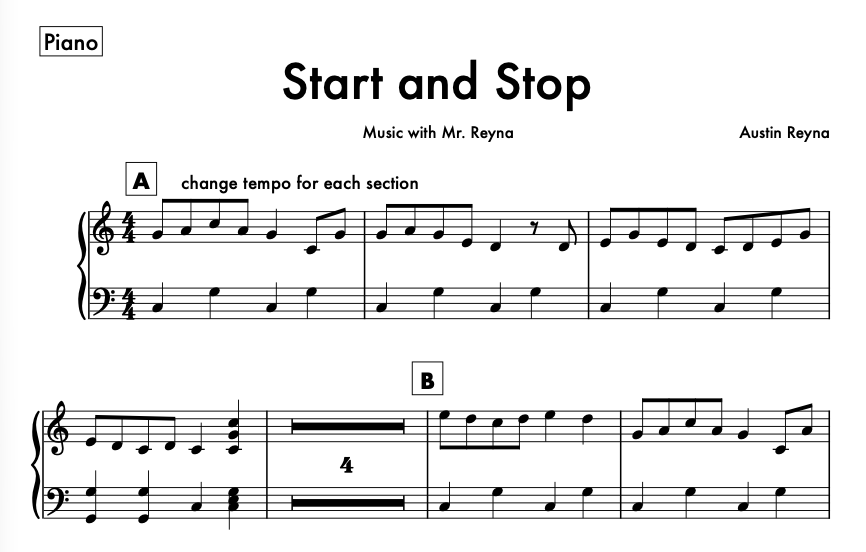
Start & Stop
Internalizing the beat through movement and silence

Start & Stop is a Dalcroze-inspired movement and listening activity that challenges students to keep a steady beat—even when the music disappears!
Students listen to a steady beat, move through the space, and then continue to feel and count that beat internally during periods of silence. As their confidence grows, the activity is reversed: students stand still while they hear the music and move only during the silent beats.
How to Teach It
Part 1: Move with the Sound
Begin by establishing a clear, steady beat.
Play 16 steady beats while students walk around the room, taking one step on each beat.
After 16 beats, stop playing.
Students freeze, but the beat should continue inside their heads.
They silently count or feel another 16 beats: 1 – 2 – 3 – 4 … 13 – 14 – 15 – 16
When the silent 16 beats have finished, begin playing again. Students should attempt to begin walking on the exact same beat that you resume playing.
Repeat several times.
Change the tempo
Once students understand the activity, vary the tempo.
Try a slower walking beat, followed by a faster one. Each time, students must establish the new tempo strongly enough that they can maintain it during the silence.
This is important: students aren’t simply learning that they have to wait for a certain amount of time. They are learning that 16 beats lasts a different amount of time depending on the tempo.
A slow 16 beats feels very different from a fast 16 beats!
Part 2: Move in the Silence
This time, students stand still while they hear the steady beat.
Play for 16 beats while students listen and feel the pulse without moving through the room.
Then stop playing.
As soon as the sound stops, students begin walking and continue for what they believe is 16 beats, maintaining the tempo they just heard.
At the end of those 16 internal beats, you begin playing again—and the students freeze.
This reversal is an excellent additional challenge because students must transfer the beat they were hearing into physical movement after the external sound disappears.
Note: sometimes my students like to stop their feet to audibly hear the beat, and while this does help, I ask them to walk silently so that they can individually internalize the beat rather than relying on the stomping feet of others to hear the beat.
Using the Start & Stop Video
The Start & Stop video provides students with a visual model of the activity and can be especially useful when first introducing the concept.
Students can follow along with the video to understand when they should move and when they should freeze.
However, once students understand the game, I recommend moving away from the visual cues.
Try it without the screen!
Use the included Start & Stop MP3 and have students complete the activity through listening alone.
Removing the visual reference is an important part of the learning experience. If students can see exactly when the movement is going to begin or stop, they may start relying on their eyes instead of maintaining the beat internally.
Extensions & Challenges
Once students are successful with the basic activity, there are lots of ways to extend it.
Change the number of silent beats. Try 8 beats instead of 16, or challenge older students with longer stretches such as 24 or 32 beats.
Change the locomotor movement. Walk, tiptoe, march, slide, or use another movement appropriate to the tempo.
Add conducting. During the silent section, students can silently conduct the beat while keeping their feet still.
Try different meters (better for upper grades) Once students are ready, explore whether they can maintain the pulse while also feeling groups of 2, 3, or 4.
Student leader. Allow a student to establish the tempo and control the sounding and silent sections while the rest of the class responds. If they cannot play a piano, have them play a steady beat on a drum.
What Is Dalcroze Eurhythmics?
Dalcroze Eurhythmics is an approach to music education developed by Swiss musician and educator Émile Jaques-Dalcroze. A central idea of the approach is that musical understanding can be developed through purposeful movement, listening, and physical experience.
Rather than only explaining musical concepts verbally or showing them through notation, students experience elements such as beat, rhythm, tempo, phrasing, dynamics, and meter through their bodies.
In an activity like Start & Stop, students aren’t simply being told what a steady beat is. They walk it, feel it, lose the external sound, maintain it internally, and discover whether their internal beat matches the music when it returns.
That moment when the music comes back is immediate feedback. If everyone begins together, the class maintained the pulse successfully. If students begin at noticeably different times, that’s okay, the discrepancy becomes part of the learning experience.
Resources
More from the Blog