Routines in the Elementary Music Classroom
The elementary music classroom is an active, joyful, messy, but beautiful environment that sees hundreds of kids coming through each week. If you’re like me, there are many different components to a lesson: warm-ups, singing, rhythm practice, solfège practice, instrument playing, movement, creating, group work, partner work, folk dances, and more. Routines are necessary to ensure each component of the lesson runs smoothly and are absolutely essential for reducing behavior concerns. Routines help keep kids safe, responsible, and respectful—and quite frankly, they thrive on them.
This year, one of my professional goals is to really nail down and reinforce the routines in my classroom in a meaningful way. Of course, I’ve always used routines in my class. I’ve always had an entrance routine, an exit routine, a “grab your recorder” routine, a routine for going to barred instruments, and one for making circle formations. However, this year I’m making these routines more visual through a series of posters I created in Canva. Visual reminders can be particularly helpful for students who benefit from having expectations presented in more than one way. They also reinforce my verbal directions and make routines feel more concrete. Sometimes, instead of explaining an expectation all over again, I can simply point to the routine poster.
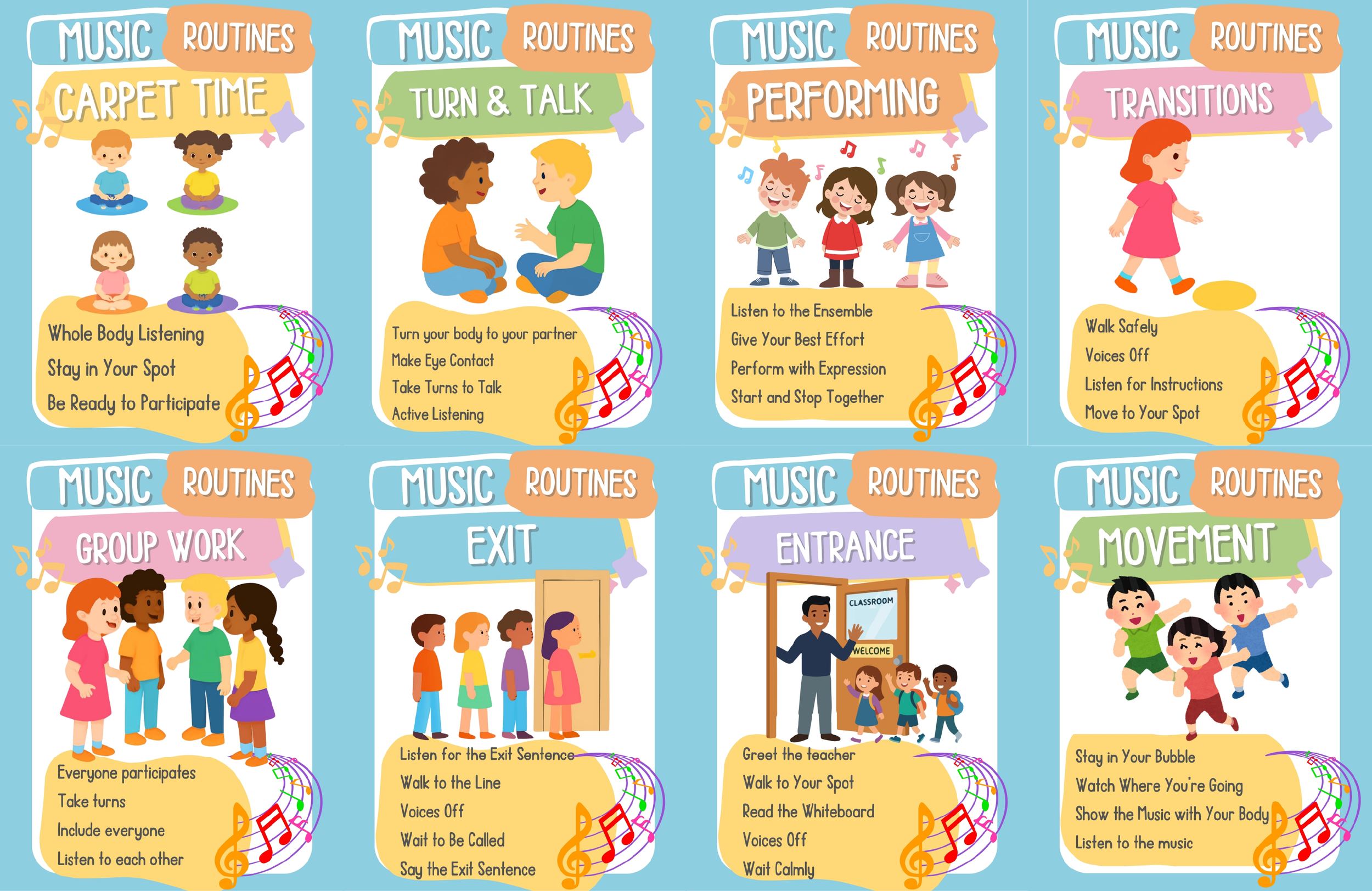
Download links at bottom of page
My Routines
Below are my list of routines Not every routine receives a poster, because I have a lot of routines.
Entrance
Greet the teacher
Walk to your spot
Read the whiteboard
Voices off
Wait calmly
I have a green line outside of my classroom in the hallway. When the homeroom teacher drops off the students, they wait on this green line. When I greet them outside, I briefly review the entrance routine, then welcome them in. As they walk to their spots, they will see my Classroomscreen showing the objectives, welcome message, announcements, and a reminder of their carpet spots if we recently changed spots. I also have calm music playing quietly, and I try to vary up the genres each time.
Carpet Time
Whole Body Listening
Stay in your spot
Be ready to participate
This routine is nothing new, but I’m intentionally giving it a name this year and using this poster to refer to it.
Performing
Listen to the ensemble
Give your best effort
Perform with expression
Start and Stop together
Again, this is nothing new, but this will help me reinforce expectations for when we are singing or playing instruments.
Transitions
Walk Safely
Voices off
Listen for instrucitons
Move to your spot
This is probably one that I review and reinforce the most. My classroom is large, so this is especially helpful when we are making transition from carpet spots to movement spots or to barred instrument spots. However, depending on where we transition to, there is usually an additional set of expectations that I explain, such as when we go to the barred instruments.
Turn & Talk
Turn your body to your partner
Make Eye Contact
Take Turns to Talk
Active Listening
My school is heavily emphasizing the turn & talk routine, and it’s one that often comes up on my evaluation feedback; I simply don’t do enough of it. So I’m intentionally planning for meaningful uses of the turn & talk routine. I might give a prompt such as “Turn and talk to your partner about remind them how we go to the barred instruments” or “Explain to your partner what a time signature means”. I’m also trying out assigned turn and talk partners for each of my classes. I haven’t started using the assignments yet, but plan to do so in the next few lessons. We’ll see how that works out!
Group Work
Everyone participates
Take Turns
Include Everyone
Listen to Each Other
I’ve always found solving disagreements during group work difficult, especially when you get the “no one is listening to my idea!” response from a student. This won’t necessarily make those situations go away, but it helps set up the expectations before group work begins, and I can easily refer to it when there are group disagreements.
Movement
Stay in your bubble
Watch where you’re going
Show the music with your body
Listen to the music
This one is very important because it keeps kids safe while also engaging fully with their bodies and the movement. I probably should have put Listen to the Music before Show the Music With Your Body, but I think the current order still works.
Exit
Listen for the Exit Sentence
Walk to the Line
Voices Off
Wait to Be Called
Say the Exit Sentence
My exit routine has been solid for several years now. At the end of each class, I show them an exit sentence on the screen with a sentence starter. It could be a simple sentence such as “My favorite part of today’s class was…” or something more related to a concept we are learning “To make a good sound on the recorder, I should…”. Then I have my students line up on the green line that leads towards my exit door (I have two in my classroom). As they are lined up, I cold call a random student using iDoceo’s random name caller, and the student who is called must answer the exit sentence. After two or three cold calls, depending on time, I usually call a few volunteers, as there are always kids eager to answer exit sentences.
Teaching the Routines
Routines must be introduced early and they must be consistently reinforced. That being said, I don’t introduce every routine in the first, second, or even third class. Some routines, like group work, won’t be introduced until we do an activity that requires it. I have many other smaller routines like going to the barred instruments, getting your recorder, passing out papers, grabbing a ukulele, etc., that I don’t introduce right away. I still always reinforce the routine by pointing to the posters on the wall, discussing it, or using a think-pair-share routine, where I ask students to first think about a routine such as movement, talk with their partner about what it means, and then share out. This also helps shift the balance of the teacher vs. student ratio, something that I’m also trying to work on.
Modeling is also very important. It may feel unnecessary and that it takes too much time, but modeling a routine myself, then asking a student to model it, then discussing what the model student did is absolutely critical for teaching and routines. Not every student can learn something just by hearing a teacher explain it. I also am not afraid of having students redo a routine such as a transition or entrance routine, as this helps reinforce the idea that it must be done a certain way, usually for safety purposes.
Using the Posters
Make sure you choose only the posters relevant to your room. Explicitly teach each one. Don’t waste wall space in your room. Try to display posters near where the routine actually happens. I actually have limited wall space because most of my walls are just storage shelves and windows on both sides of the classroom, plus a giant mirror on one side. I keep mine all at the front of my classroom, but asked our copy center to print them in a poster size so that they are easier to see from a distance. Make sure to use them as a visual reminder rather than something students are expected to memories.
I’ve linked below the PDF of all the posters, plus