Wacky Phrygian
Exploring the strange-sounding mode with Orff instruments.
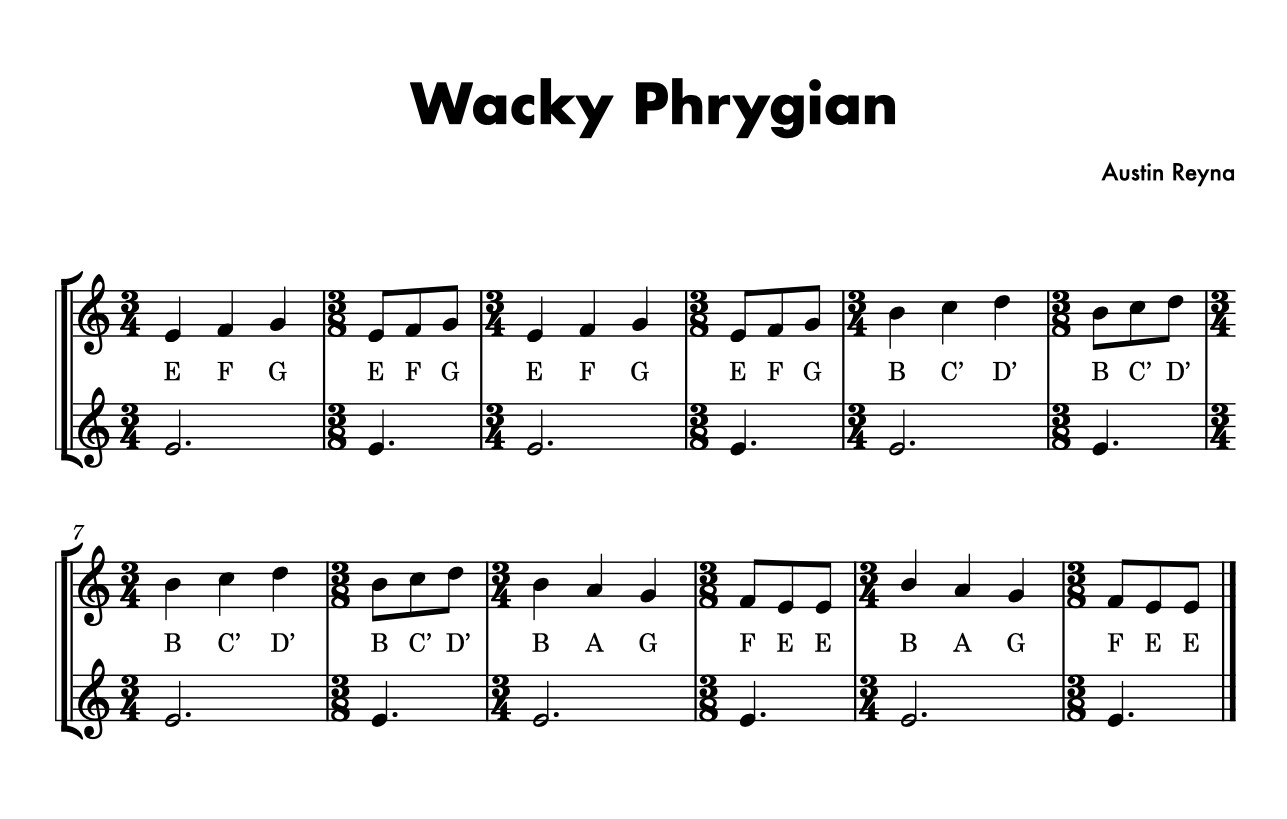
Wacky Phrygian is an arrangement for barred instruments and percussion that explores the strange-sounding Phrygian mode. Every year, I go through the different modes with my Grade 5 students. We explore how each of them sound and how we might respond to the way they make us feel. There’s not a lot written for the Phrygian mode suitable for elementary students, so I wrote a melody that gives the most some well-deserved attention. We also look at mixed-meter music in Grade 5, so I wrote the piece in an alternating 3/4-3/8 meter to give it an even more uneven feel.
Structure of the Piece
There is a lot you can do with this piece beyond what is shown in the video. The whole piece is based on the melody, which repeats several times, and the bass line, which gives the macro-pulse of the mixed meter.
The structure of the piece that is used in the video is below:
Drone
Bass line, unpitched percussion
Melody x2
Interlude with just bass line
Group 1 Melody
+Group 2 Melody
+Group 3 Melody
+Group 4 Melody
Final Melody
Ending on E
I use a drone at the beginning, which is played from a Korg Volca Keys that we have in our classroom. But you can also use a bass bar tremolo, cello or double bass, piano tremolo, electronic pad from a piano keyboard or synthesizer, and much more.
For the bass line, I had a student play the bass bars, bass metallophone, and a student on electronic bass. All you have to do is pluck the open E string; they don’t even need to know how to play bass! If you don’t have any of these, just use the bass xylophone, boomwhackers, piano, or perhaps a band instrument. One of my trombone players borrows my plastic p-bone to use in our performance.
After the interlude, I layered in the melody by having four different groups perform. Group 1 was lower instruments like Bass Xylophones. Group 2 was Alto Xylophones. Group 3 was Soprano Xylophones, and Group 4 was glockenspiels. You could also just randomly assign students to a group or let them pick a group. It doesn’t have to be by instruments.
Lesson Extensions
There are lots of ways to extend Wacky Phrygian beyond the play-along video! Here are some ideas to encourage creativity, improvisation, movement, and a deeper understanding of the Phrygian mode.
1. Improvisation
Have students improvise their own melodies using the E Phrygian scale (E–F–G–A–B–C–D). Begin with short, four-beat phrases over a sustained E drone or the repeating bass line. Students can take turns improvising individually, in pairs, or as a question-and-answer activity. Keep in mind that the piece is in mixed meter, but for improvisation, it may be easiest to move to 4/4. For an extra challenge, encourage students to incorporate the alternating 3/4 and 3/8 meter into their improvisations.
2. Play the Melody on Recorder
Challenge students to transfer the melody from barred instruments to soprano or alto recorder. Depending on their experience, students can learn the melody by ear, read from notation, or work together to figure out the fingerings. You can also divide the class into recorder and barred instrument groups to create a new arrangement of the piece.
3. Explore Other Modes
Try moving the melody up or down to explore how its character changes. By moving the melody up one diatonic step, students can explore F Lydian. Moving it down one step produces D Dorian. Have students listen to each version and discuss how the different modes affect the mood and character of the piece. Which version sounds the strangest? Which is their favorite?
4. Creative Movement
The unusual character of the Phrygian mode and the alternating meter make this piece a great opportunity for creative movement. Invite students to develop movements that reflect the mysterious or unusual sound of the music. They might create contrasting movements for the 3/4 and 3/8 measures or develop a short movement sequence that follows the structure of the piece. Students could also work in small groups to create and perform their own choreography.
5. Explore the Mixed Meter
Have students experience the alternating 3/4 and 3/8 meter through body percussion, movement, or unpitched percussion instruments. Challenge them to create a repeating rhythmic ostinato that fits the meter. Students can experiment with different combinations of clapping, patting, stamping, and playing instruments while maintaining the underlying pulse.
6. Compose a New Melody
Once students are familiar with the Phrygian mode, challenge them to compose their own melodies using the same collection of notes. They can begin by creating a short phrase, then extend it into a longer composition. Encourage them to experiment with the distinctive half-step between E and F, which helps give the Phrygian mode its unusual sound. Students could perform their compositions over the existing drone or bass line.
7. Create Your Own Arrangement
Give students the opportunity to arrange the piece themselves. Which instruments should play the melody? When should the percussion enter? Should the melody be performed by everyone together or introduced gradually in layers? Students can experiment with dynamics, instrumentation, texture, and form to create their own unique version of the song. In addition, encourage them to come up with their own name for the piece.
8. Add New Percussion Parts
Invite students to create additional rhythmic ostinati using hand drums, tambourines, shakers, or other unpitched percussion instruments. Encourage them to consider how their patterns fit within the alternating meter and complement the existing parts. Small groups can develop different patterns and combine them to create a layered percussion accompaniment.
9. Compare the Modes
Use Wacky Phrygian as a starting point for exploring the seven musical modes. Play examples of music in different modes and ask students to describe how each makes them feel. Students can compare the intervals, tonal centers, and overall character of the modes. Encourage them to use musical vocabulary to explain why two modes might sound different, even when they use the same collection of notes.
10. Student Conductors
Let students take turns conducting the ensemble and making musical decisions. The conductor can determine when different groups enter, when to change dynamics, or when to bring the piece to an ending. This is also an excellent opportunity for students to practice active listening, nonverbal communication, and ensemble awareness.
Resources